
You should arrange your first antenatal consultation as soon as possible
Contact your local health centre or GP to arrange your first pregnancy consultation when you know you are pregnant. You can find the contact information for the health center or midwife in your municipality on the municipality's website.
If you have taken a pregnancy test at home and it is positive, this home test is as reliable as the one offered by your doctor or midwife.
You should be given an appointment within a week. You can choose whether you want follow-ups during your pregnancy from your GP or midwife. You can also choose to alternate between them.
It’s a good idea to bring morning urine to all your consultations for urine tests.
Consultations during weeks 6-12 of pregnancy
At the first consultation, your midwife or doctor will talk to you so that together you can agree on your needs during your pregnancy and what is important to you. This early consultation is about your lifestyle and preparation for pregnancy and how you can get the healthcare you need during pregnancy.
You will receive information about follow-ups during your pregnancy (prenatal care) and maternity services where you live.
You will be given an Antenatal Health Card which gets filled in. Bring the card with you to each consultation. See more about the health card here and which tests are recommended. During the conversation, the following will be discussed:
- diet, exercise, smoking and alcohol
- your health and any illness and use of medicines
- previous pregnancies, births, maternity leave, breastfeeding and any abortions
- mental health
- any experience of violence and abuse
- declaration of paternity if you and the father of your child are not married
- Application for co-motherhood in same-sex relationships
At all the consultations, you can ask about common ailments and changes to your body during pregnancy.
You will be offered a blood pressure test and a simple test of proteins in urine, as well as a blood test in order to test for the following: hepatitis B, HIV, syphilis, haemoglobin (blood percentage) and serum ferritin (iron level). Weight before pregnancy is recorded on the health card.
You will be offered an RhD blood test. The blood test is taken to check whether you have the Rhesus negative blood type. If you are found to be Rhesus negative, a new blood test will be taken later to check the fetus's blood type. You can read more about this on the Oslo University Hospital website.
Other tests are assessed if necessary.
Consultation during weeks 11 – 14 of pregnancy: fetal diagnostics
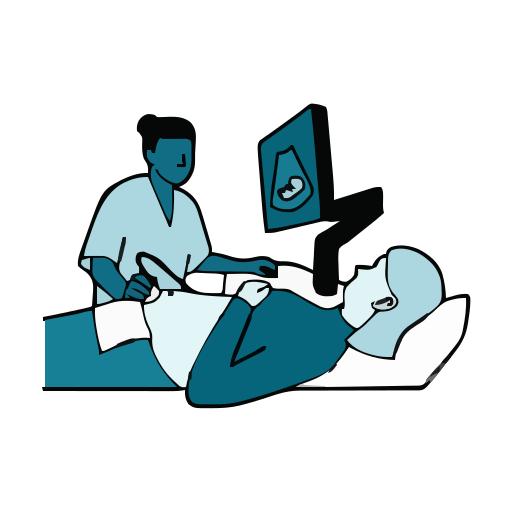
During these weeks, prenatal diagnostics can be performed. All pregnant women should be offered an early ultrasound in weeks 11-14. Pregnant women over 35 or pregnant women with special indications may be offered a NIPT test. It is voluntary to accept this offer, and you must give your consent for an early ultrasound or NIPT to be performed.
You can find information about fetal diagnostics here:
Prenatal diagnostics in Norway
Fosterdiagnostikk er undersøkelser av fosterets helsetilstand.
Consultation during weeks 17-19 of pregnancy - ultrasound to determine due date
In weeks 17 to 19, you will be offered a routine ultrasound. The purpose of the examination is to check the development and anatomy of the fetus, check the position of the placenta, and set the due date.
You can find information about ultrasounds here:
Routine ultrasound examination of pregnant women
All pregnant women in Norway are offered two ultrasound examinations during their pregnancy.
Consultation during week 24 of pregnancy
Your midwife or GP will ask you how you feel being pregnant. They will offer to carry out a blood pressure test, a simple test of proteins in urine, and to weigh you.
Symphysis-fundus measurement
At this consultation, how the fetus and uterus are growing will be examined by measuring the distance between the top of your pelvic bone and the top of the uterus. The result will be noted on your health card. This measurement will be performed during each consultation from week 24 onwards.
Fetal heartbeat and movements
The fetal heartbeat will be examined. It will be noted on your health card if you can feel fetal movements. You will also be told what to look out for and what you should do if your baby is not as active as it should be.
Information about inactivity during pregnancy: Inactivity during pregnancy - Oslo University Hospital (oslo-universitetssykehus.no)
Gestational diabetes
If you are a first-time mother over 25 years of age or are at risk of developing gestational diabetes, you will be offered an oral glucose tolerance test (OGTT).
Have you been diagnosed with blood type RhD negative?
If you have been diagnosed with RhD negative blood type, a new blood test will be taken in week 24 to determine your baby's RhD type. You can read more about this on the Oslo University Hospital website.
Whooping cough vaccination
You will be offered a vaccine against whooping cough.
Consultations during weeks 28 and 32 of pregnancy
Your midwife or GP will ask you how you are. They will offer you a blood pressure measurement, a symphysis-fundus measurement, a simple test of proteins in urine as well as listen to the fetus’ heartbeat and weigh you. You will also be asked about the movements of the fetus.
If the fetus has RhD positive blood and your blood is RhD negative, you will receive an injection in week 28 that prevents a reaction between your blood and your child’s blood.
In the consultations you can talk about childbirth, maternity leave, breastfeeding and recommendations on infant nutrition.
Breastfeeding
Morsmelk er den beste maten for spedbarnet ditt. Det er bra for barnet å få morsmelk hele det første året.
Consultation during week 36 of pregnancy
The content of this consultation is pretty much the same as the previous two. In this consultation, the location of the baby in the uterus will also be checked. The vast majority of babies lie with their heads down in the birth canal, i.e. your pelvis. If the child’s buttocks are facing the birth canal instead of the head (breech position), you will be referred to the maternity outpatient centre for an assessment and plan for further follow-up.
It is recommended that the midwife and doctor talk to you about:
- birth
- the first few days and weeks after the birth
- home visits by a midwife and public health nurse
- follow-up of your baby by the health centre
Consultations during weeks 38, 40 and 41 of pregnancy
The final consultations are very similar to the previous ones. Your blood pressure will be checked, your weight will be noted, your urine sample will be tested, and the fetus’ heartbeat will be recorded. The orientation of the baby in your womb will also be checked.
This is a good opportunity to address issues you want to know more about or want to discuss, or if there is anything you’re having difficulty with. The aim is to ensure that you and your partner feel as safe and secure as possible.
Pregnancy past due date
You should be offered a consultation at the hospital within a week of your ultrasound appointment.
The hospital is then responsible for further follow-ups of you and possible induction of labour.

Childbirth
Childbirth typically starts with contractions and consists of three stages of labour: the dilation stage, expulsion stage and placental stage. The time it takes to give birth varies from woman to woman.
Illustration: Doug Olson / Mostphotos
Other samples and tests as necessary
Rubella
If you have not received two doses of vaccines against rubella or been shown to have an antibody, you will be offered a blood test to determine if you are still protected.
If you do not have antibodies, you will be offered a vaccine after you have had your baby. You can get the vaccine at a health centre or from a GP.
Hepatitis C
You should be examined for hepatitis C if you as a pregnant woman may have been exposed to infection.
Toxoplasmosis
You can test yourself to see if you have antibodies for toxoplasmosis in your blood. This is recommended if you have a cat or if you visited the Mediterranean region immediately before or during your pregnancy.
Chlamydia
You should test for chlamydia if you are under the age of 25 and/or have had several sexual partners. Chlamydia is a sexually transmitted infection in the genital organs, which can occur in the urethra, uterus and fallopian tubes. Chlamydia does not always cause symptoms.
Herpes
If you experience a herpes outbreak around your genitals for the first time during your pregnancy, you should discuss the matter with your GP or midwife. You will be referred to a gynaecologist for further follow-ups.